
Have high-speed internet? Switch to High-Speed
Videos load too SLOW? Switch to Low-Speed
NDNs & DOGs Hybrid Documentary 91-94
About
INDIANS & DOGS / NDNs & DOGS
HISTORY, DEVELOPMENT AND HYBRID MULTIMEDIA RESTORATION
1985–1995 and Beyond
Indians & Dogs is an approximately 90-minute multimedia theatre work that I developed and presented between 1991 and 1994. Its origins, however, reach back into my theatre, writing and political-performance work of the mid-1980s.
The work combined live theatre, Indigenous oral storytelling, poetry, original music, improvisation, satire, video, live-feed imagery, computer graphics and animation. It emerged during a period when multimedia performance was still developing as an artistic form and when Indigenous artists were creating new ways of bringing our languages, histories and contemporary experiences into theatres, galleries and emerging media environments.
This restored 4K digital edition is not simply a recording of one performance. It is a hybrid documentary reconstruction assembled from surviving footage of the 1991, 1992 and 1994 productions, together with rehearsals, songs and other material created by members of the company.
ORIGINS: THE YOUNG POUNDMAKER AND WILLIE KITE
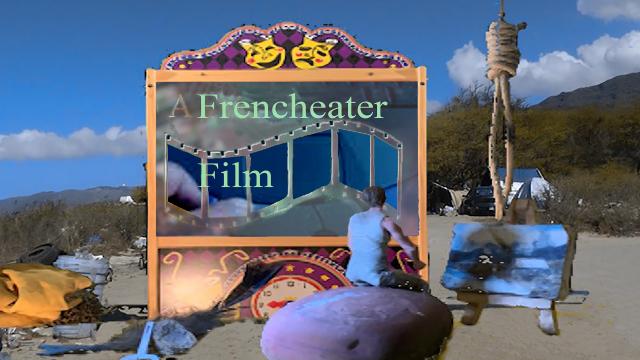
An important precursor to Indians & Dogs was my 1985 work The Young Poundmaker. The character of Willy Frencheater developed partly from ideas surrounding the earlier Willie Kite character, my family and historical associations with the Frencheater name, and the political-performance work I was creating throughout the 1980s.
These early works were already asking questions that would become central to Indians & Dogs: How does an Indigenous person understand himself within a colonial society? What happens when education, political anger, cultural memory and Western institutions collide inside one person? How do we recover our voices after generations of other people speaking for us?
MEETING NEIL BENSON
In 1986, I met the late Gitxsan poet and playwright Neil Benson through the Chief Dan George Memorial Foundation’s video-training program.
Neil and I came from very different linguistic and educational experiences. His English carried the rhythms and structures of his Gitxsan-language background. I was writing from the position of a much more Westernized and assimilated university-trained Indigenous artist.
That contrast became artistically important. Neil eventually gave me permission to juxtapose his writings with my own. By placing those different voices and literary structures beside one another, I began exploring the relationship between Indigenous oral and traditional literacy and Western literary forms.
This was not about deciding that one form of expression was superior to the other. It was an experiment in creating a new performance literacy—a language in which oral storytelling, written text, music, movement, video and contemporary Indigenous experience could exist together.
FROM DEVELOPMENT TO PRODUCTION
During the late 1980s, the ideas continued to develop through my work in theatre, modern dance, music, video, political performance and experimental multimedia.
In 1990, I received a Canada Council theatre-project grant for Indians & Dogs. The grant recognized the work as being adapted and developed from the writings of Benson and Morin.
The first major presentation took place during the NEO-NATIVISTS exhibition at Pitt Gallery in Vancouver, held from October 14 to November 9, 1991. The exhibition was curated by Dana Claxton and Leonard Fisher Jr.
Artist Rick Harry created the Kanesatake installation that appeared in the original 1991 NEO-NATIVISTS performance. His contribution gave the production another visual and historical dimension, connecting its themes to the events surrounding Kanesatake and the larger political realities confronting Indigenous peoples in Canada.
The work continued to develop through performances in 1992 and 1994, including productions associated with the Neo-Nativist Festival, Earth Voice Festival and the National Native Youth and Multicultural Conference.
The 1994 performance history included a major presentation at the Hotel Vancouver connected to a national Native and multicultural education conference. The stage production that year was directed by the late Lisa Sazama.
CHARACTERS AND PERFORMERS
At the dramatic centre of Indians & Dogs were Danny Dog and Willy Frencheater.
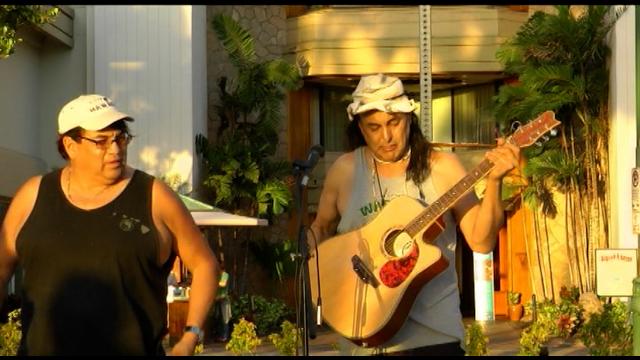
The late Jimy Sidlar portrayed Danny Dog, while I performed the role of Willy Frencheater. Jimy’s earlier performance work and his particular creative energy influenced my decision to cast him. He became an important longtime collaborator in the development of the piece.
Danny Dog and Willy Frencheater represented two clashing Indigenous voices attempting to locate themselves within colonialism, assimilation, cultural memory, commercial society and competing systems of value.
Danny Dog represented a more traditionally grounded counterforce. Willy Frencheater was the angry, politically educated and increasingly conflicted Indigenous man who had become entangled with Western education, commercial culture and the institutions of the dominant society.
They argued, sang, improvised and confronted one another as they tried to recover their voices. Their conflict became an allegory of Contact—not only the historical meeting between Indigenous and European civilizations, but the continuing contact between different languages, spiritual systems, economies and understandings of the world.
The late Grace Meyerhouse, an educator and administrator at the Native Education Centre in Vancouver, immediately recognized the work as an allegory of Contact. Her observation has remained central to my understanding of the piece.
The performance company also included the late James “Jamee” Nicholas as Mr. Bodean and Anthony Favel McNab as the Spirit Guide. Kim Soo Goodtrack contributed computer graphics, production design and important creative and financial support to the project.
This restoration features Jimy Sidlar, James Nicholas, Anthony Favel McNab, Kim Soo Goodtrack and myself, along with surviving material from the larger creative process.
AN ALLEGORY OF CONTACT
What happens when two civilizations enter into sustained contact?
How do people respond to the pressures, promises, violence and losses that follow? What is remembered, what is resisted and what is sacrificed when a dominant society demands assimilation?
Indians & Dogs explored Indigenous tradition, resistance, political anger, cultural memory, dysfunction, survival and the struggle to exist between competing cultural worlds.
The work also examined differences within Indigenous communities. People do not all respond to colonialism in the same way. Some struggle to retain cultural traditions; some adapt in order to survive; some resist colonial institutions; and others become caught between identities and different understandings of who they are.
Through humour, confrontation, music, satire and improvisation, Danny Dog and Willy Frencheater attempted to find a language capable of expressing those contradictions.
A MULTIMEDIA PERFORMANCE LANGUAGE
Indians & Dogs was never intended to be conventional theatre.
Live performance was placed in conversation—and sometimes in conflict—with prerecorded video, live-feed imagery, poetry, songs, animation, computer graphics and Indigenous oral storytelling.
The collisions between these forms were deliberate. Western dramatic structure could be interrupted by oral storytelling. Political dialogue could become music. A live performer could encounter a prerecorded image or a digitally constructed version of himself. Memory, history and contemporary reality could appear simultaneously.
For me, the multimedia form reflected the divided and layered experiences of the characters. It allowed different histories and systems of knowledge to occupy the same performance space without being forced into one conventional theatrical structure.
ORIGINAL VIDEO AND COMPUTER TECHNOLOGY
The original documentation was recorded on C-VHS, VHS, S-VHS and Hi-8 videotape.
Editing was completed using a Sony S-VHS editing deck capable of insert editing and basic two-channel sound. Hi-8 camera footage was transferred through a G-Lock device into a Commodore Amiga computer equipped with a 64 MB hard drive. The completed signal was then assembled back onto the Sony deck.
Computer graphics, titles and animation were created using the Commodore Amiga platform, including Brilliance. Anthony Favel McNab contributed graphic work, Kim Soo Goodtrack created additional computer graphics, and I created the animation.
For its time, the Commodore Amiga was an extraordinary creative instrument. It allowed me to combine video, animation, computer graphics, title design and music composition within one integrated artistic process.
CONTINUATION INTO 1995
The performance history continued into the 1995 Red Jam Slam period. My archive preserves an approximately 40-minute work titled NDNs & DOGs, Friends & The Hussies, connected to that event.
This later material demonstrates that Indians & Dogs did not end with the 1994 stage production. Its characters, songs, performance strategies and political questions continued evolving through new collaborations and performance environments.
THE RESTORATION
For this restoration, I repaired visual glitches wherever possible, reprocessed and strengthened the surviving audio using Adobe Audition, and reconstructed the project in Adobe Premiere Pro.
The completed hybrid documentary combines footage from the three principal performance periods with rehearsals, songs and other surviving production material. Because these recordings come from several generations of analogue videotape, some visual and audio deterioration remains.
This restoration preserves the character of the original recordings while making the work accessible to contemporary audiences. When I can secure a professional Hi-8 playback deck and improved capture equipment, I hope to undertake a more complete digital restoration directly from the original tapes.
This version was completed in time for the birthday of Jimy Sidlar’s grandson, to whom I had previously sent a restored audio recording of the performance. That personal connection gave the reconstruction an additional meaning by allowing Jimy’s voice, presence and creative work to reach another generation of his family.
FROM INDIANS & DOGS TO AS A KODEN
Indians & Dogs is not simply an earlier play sitting behind my present work. It is part of the artistic and dramatic DNA of my feature-film project:
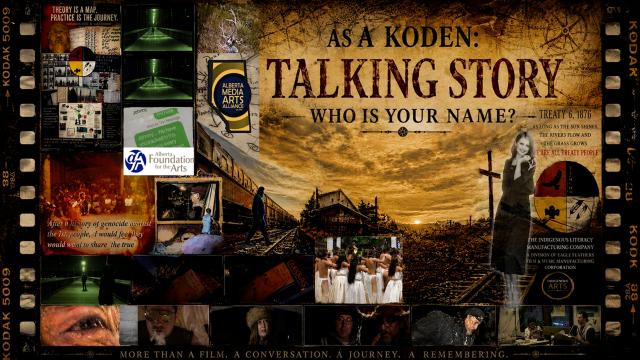
AS A KODEN: TALKING STORY—WHO IS YOUR NAME? — kihcihkaw askî (Saulteaux: Sacred Earth).
Willy Frencheater survives the original theatrical work and transforms across the decades into the older, more ambiguous and elusive figure who now exists within As A Koden.
In the new film, he is understood largely through recordings, news reports, archival material, political accusations and the memories of other people. His earlier anger has been changed by age, history, spirituality and his relationship with the ancestors, but the central questions remain.
Who defines an Indigenous person in Canadian society? Who controls the public image of resistance? What happens when colonial institutions turn a human being into a symbol, threat or political construction?
The original conflict between Danny Dog and Willy Frencheater has therefore developed into a much larger examination of Canada’s colonial “Heart of Darkness,” including the relationship between Frencheater, Aeliana and the generations who inherit these unresolved histories.
PRESERVATION AND CONTINUING LIFE
Whether viewed on YouTube or through Indigenous media platforms, I hope Indians & Dogs continues to find new audiences.
Indigenous-controlled platforms provide an essential home for our stories, histories and communities. YouTube allows the work to reach viewers throughout the world. Together, these spaces can help preserve and share this chapter of Indigenous multimedia theatre history with future generations.
The restoration honours everyone who contributed to the development of the work and preserves the voices, music, experiments and relationships that brought it into being.
With respect and gratitude to everyone who helped create Indians & Dogs, and in loving memory of those collaborators who are no longer with us.
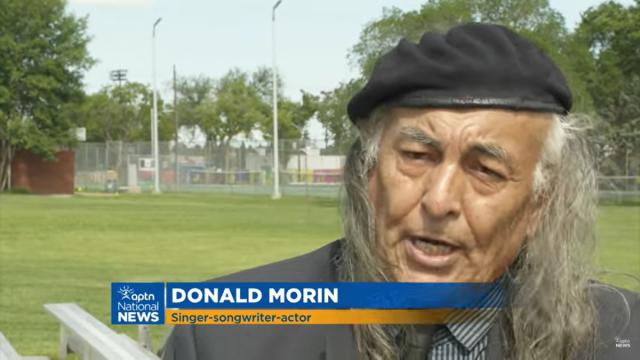
—Donald Alfred Morin